
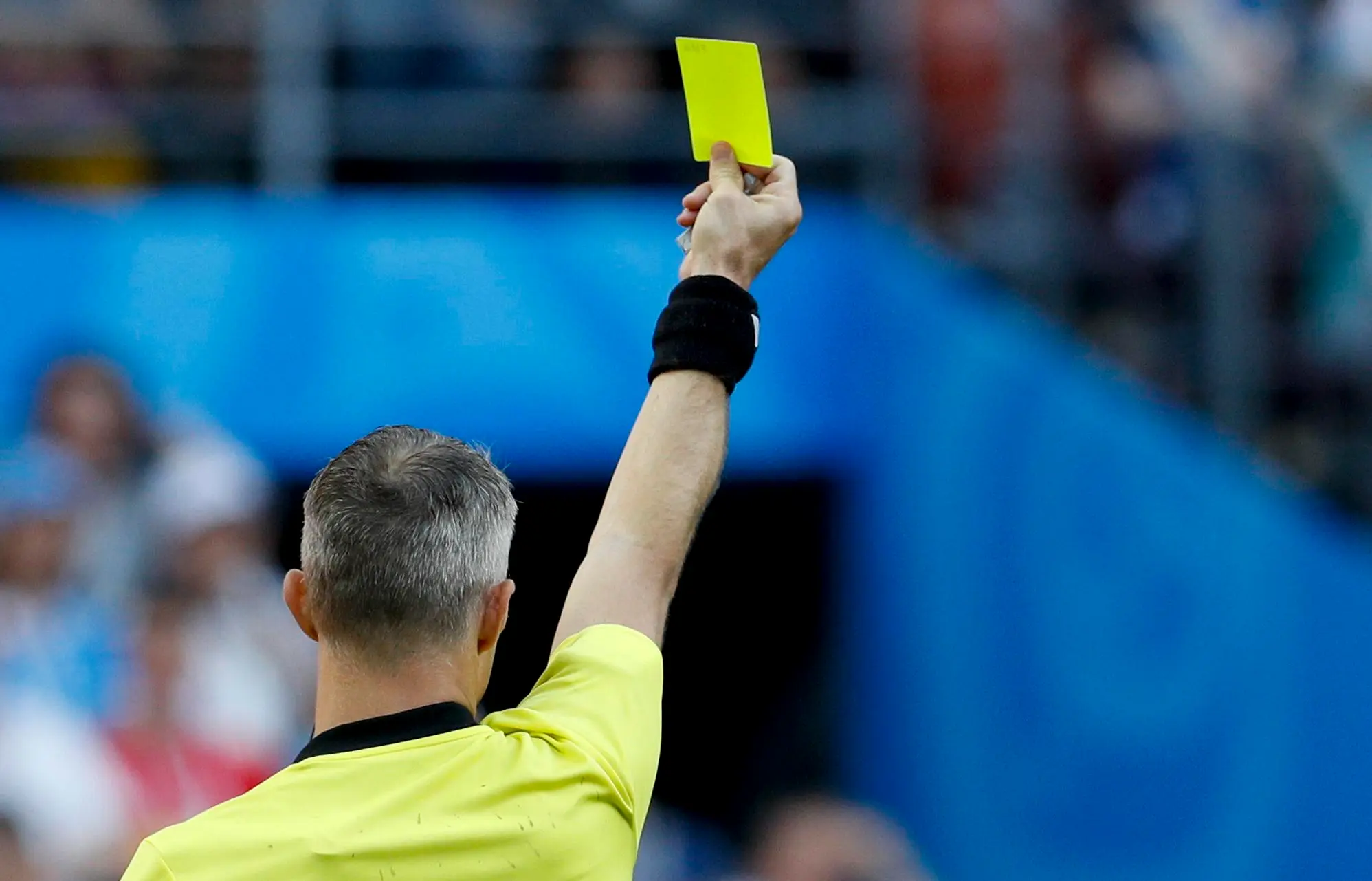
Many inexperienced players tend to bet only on the total number of goals scored or the match result, rarely considering statistics and often overlooking yellow cards. Even if they do consider such bets, they often make mistakes in their analysis.
Types of bets on yellow cards
Imagine this as the number of goals scored. Only here, we count not goals but “yellow cards.” There are different types of bets: LIVE, line (match, 1st half, 2nd half). When it comes to betting on yellow cards, MostBet offers various options to wager on different aspects of the game, providing an exciting opportunity for bettors to engage in more detailed and specific forms of betting.
Types of bets on yellow cards:
Outcome (result). It is necessary to predict the team winning by the number of yellow cards received. Our bet depends on this: P1, P2, X. You can hedge your bet by taking a double outcome: 1X, 2X, 12. Don’t forget about the handicap (zero, plus, or minus).
Total. The bet is based on the total number of “yellow cards” received by both/a specific team – whether it will be less or more than a certain total value. Different types include even/odd (an even or odd number), individual (considering a specific team’s warnings), per game (the total number of warnings), handicap (one team’s advantage over another with a specific handicap), three-way (guessing “more/equal/less” relative to a certain value).
Who will receive (team) the first/next/last yellow card.
What to consider in yellow card bets?
To conduct a quality analysis for choosing bets on yellow cards in football, it is necessary to consider several parameters.
Player analysis
A footballer is, first of all, a person who can be tough or gentle. The same goes for ball retrieval. As a result, rough violations occur, leading to cards. Conducting an analysis of the top 5 UEFA leagues’ players, leading in the number of “yellow cards,” can be done using the parimatch.com website. Look at players who receive warnings over a long distance.
In the screenshot, a statistical sample fragment:
YC – yellow cards;
Matches – the number of matches played by the player;
Average – how many yellow cards the player receives on average per match.
Be sure to check the statistics of the last 3-4 games, at what minute the player earns warnings. It is also useful to look at the team lineup, who the player acted against by position, and who they will play against.
Team playing style
Defense. Pay attention to the peculiarities of both teams’ pressing.
Let’s highlight the most important ones:
High. Athletes try to meet the opponent on their half of the field, risking a counter-attack; simultaneously, if the opponent loses the ball, they are forced to commit fouls.
Low pressing. Players withdraw to their half of the field (this depends on the opponent’s behavior). A bright example is the 06.02.2019 match “Barcelona” – “Real,” where the guests used high pressing and personal marking.
Ball recovery. Aggressive recovery increases the number of fouls. Ordinary – obvious total is lower in terms of cards. Different types of recovery are well seen during the game.
Attack. Instant transition from defense to attack, fast counterattacks – a higher probability of violation. Pay attention if the style is a prolonged positional attack; it is unlikely the opponent will often resort to rough tackles.
Importance of the tournament or match
When the game matters to a team, it needs to move forward, while the opponent begins to violate, defending the goal by any means. Often, you can come across “enthusiasts” who delay time in the final minutes, for which they are punished with “yellow cards,” especially goalkeepers. In the absence of motivation, the number of violations is minimized, and the game proceeds calmly. Let’s compare some semi-finals of the European Championship. In them, the desire and willingness to reach the final were enormous.
Referees often penalize defenders
The task of defenders is to prevent the opponent from creating scoring opportunities. They position themselves to intercept the ball, resorting to fouls in the worst-case scenario if they can’t keep up with fast players.
Let’s compare the position that was more often penalized with a yellow card in the 2017-2018 season on the championat.com website — you can view player and team statistics regarding cards. The table shows the percentage distribution of yellow cards by positions in the top European leagues. The ratio varies in each league, which is worth noting.
Outsiders receive more cards
In particular, a team that defensively sits back possesses the ball less than 44%, has a lower class of players, and commits more fouls. When one club has superiority in players: technique, speed, accuracy, the opponent tries to resist through minor fouls, consequently receiving a warning.
The role of the referee
The most significant factor in the number of shown “yellow lights” is the referee. Why do we prioritize them over players? The main task of the head referee is to enforce the rules of the game on the football field, including penalties for rough play. It is they who decide whether to award a free kick, eject a player, or let them off without punishment.
Each referee has their own officiating style. Some like to hand out “yellow cards” left and right, while others are more restrained. The officiating process is evolving, and a new tool — the VAR system, allows decisions to be made in disputed moments of the game through video replays.
Statistics of yellow cards in derbies
Derby matches — games between teams from the same region, city. It is believed that betting on the total number of cards in such matches is the most viable option. But keep in mind that bookmakers also inflate the total for such games. Let’s look at the statistics of several leagues on yellow “yellow cards” in such meetings: taking the last 12 matches.
Main referee statistics
Always start by analyzing the main referee of the match.
In addition to the refereeing body, a detailed analysis of the match is necessary, then the chances of success will increase exponentially!
Betting on yellow cards offers a more specific and detailed form of betting, allowing bettors to derive enjoyment from analyzing the game at a deeper level. Yellow card bets can be an engaging way to examine the match and invest in aspects that may be overlooked in typical outcome bets.